A new analysis of the samples brought back by NASA's OSIRIS-REx mission revealed that the asteroid Bennu has an atypical chemical composition that does not fit into any known category. According to the study published in Science Advances, this celestial body formed in a transition zone of the early solar system, and the presence of the young Jupiter played a decisive role in its formation.
A Key Discovery in Half a Gram of Space Dust
In September 2023, the OSIRIS-REx mission’s return capsule landed in Utah, carrying about 120 grams of material collected from Bennu. A team from the Swiss Federal Institute of Technology in Zurich (ETH Zurich), led by specialist Maria Schönbächler, analyzed just half a gram of these samples by studying isotopes of iron, titanium, and chromium.
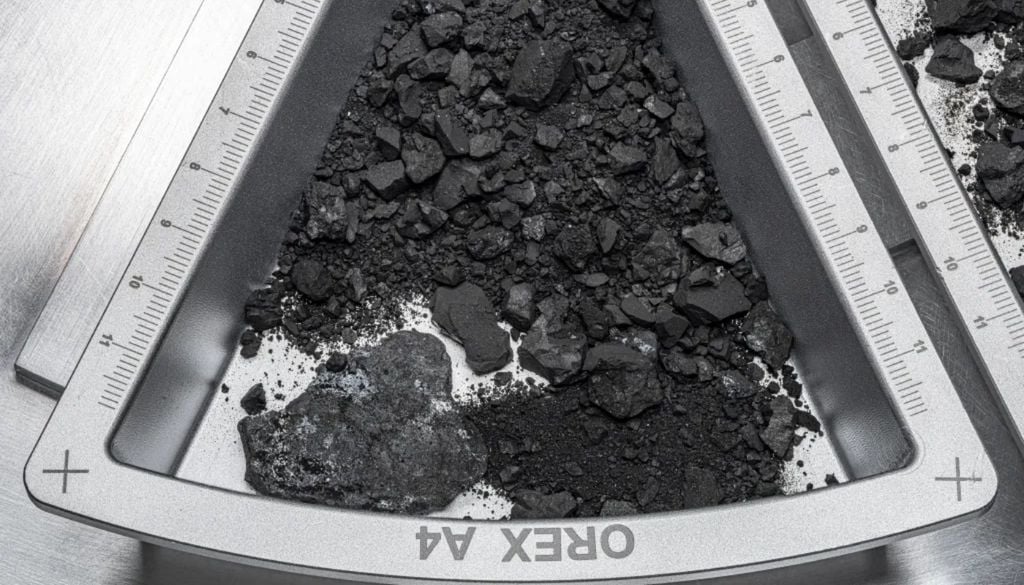
The analyses yielded the following key results:
- Unique isotopic signature: Bennu shares characteristics with the asteroid Ryugu and with CI-type meteorites, but differs from all other known planets, asteroids, and meteorites.
- Formation near the “freezing line”: Rather than forming in the outer reaches of the solar system as previously believed, Bennu likely formed near the water freezing line, where ice acted as a binder to hold the fine dust together.
- Hybrid composition: It does not belong exclusively to either the inner or outer solar system but combines elements from both regions.
Jupiter’s Invisible Barrier
The study proposes that Jupiter played a key role in the formation of these “hybrid” asteroids. As it grew rapidly during the solar system’s first million years, the gas giant acted as a natural barrier:
- It blocked large fragments: It prevented larger materials from crossing from one end of the protoplanetary disk to the other.
- It allowed fine dust to pass through: The smallest particles managed to bypass Jupiter and mix in the region where Bennu formed.
- It favored the presence of water: This explains the high abundance of water and organic matter preserved intact on the asteroid.
Thanks to its near-pristine state of preservation over the past 4.5 billion years, samples from Bennu offer astrophysicists one of the best windows into understanding the original mix of components from which the rocky planets—including Earth—formed.
Sources: Meteored
